

Excellence in High-Speed PCB Design and Manufacturing
At SMG Global, we understand that modern printed circuit boards operate at increasingly higher frequencies and faster signal switching speeds. When routing traces across a PCB, the impedance encountered by signals must be carefully controlled to ensure peak performance.
We offer comprehensive Controlled Impedance services, combining decades of manufacturing expertise with advanced modelling and testing capabilities to deliver boards with clean signals, reliable timing, and optimized data throughput.
What is Controlled Impedance?
In PCB design, impedance refers to the characteristic impedance of a trace—essentially the measure of resistance a trace offers to high-frequency signals.
- Controlled Impedance is the maintenance of a consistent impedance value along the entire length of a trace.
- Why it Matters: If impedance is uncontrolled, signals can reflect back like echoes, causing distortion and data corruption. Matching trace impedance to the components prevents these unwanted reflections, maintaining signal integrity and timing across the board.
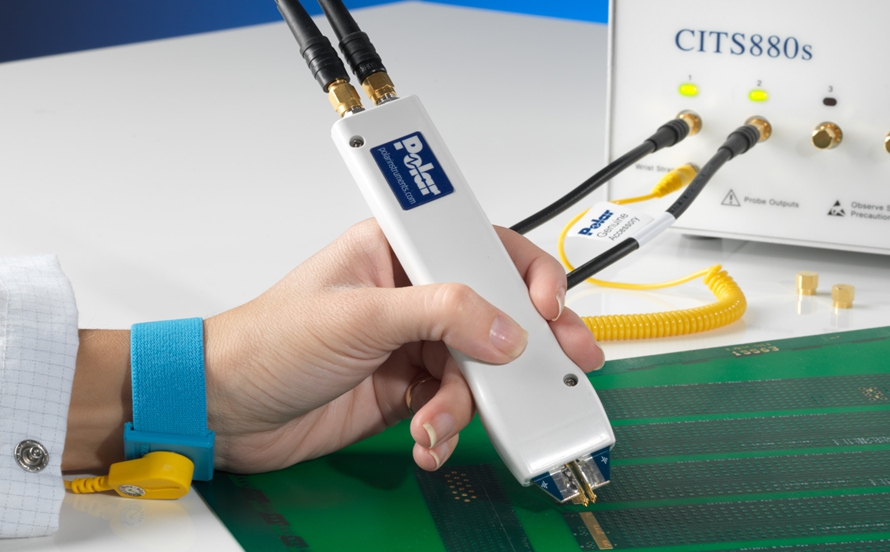
Design Factors to Consider When Addressing Impedance Control
We support a wide range of impedance standards and geometries to optimize your board’s performance. Whether you need standard 50-ohm single-ended traces or complex differential pairs, our team ensures precision.
Common Impedance Geometries
Microstrip
The most common and cost-effective type, involving a signal trace on one side of a dielectric layer with a ground plane beneath it.
Stripline
A signal trace sandwiched between two ground planes. While more complex to manufacture, it offers superior shielding and is ideal for high-frequency applications.
Dual Stripline
Similar to stripline but with two signal layers between ground planes, providing better isolation for differential signals.
Edge-Coupled Microstrip & Stripline
Configurations where traces run parallel to each other, offering excellent isolation and shielding for high-speed differential pairs.
Specialized Routing Techniques
Single-Ended Impedance
Commonly used for clock signals or ADC/DAC interfaces, we typically target 50 to 75 ohms.
Precision Tuning
We carefully tune trace width and ground spacing (typically 5-15 mils on FR-4) to hit target impedance.
Signal Integrity
Our controlled lines ensure critical nets transmit reliably without distortion.
Differential Impedance
For high-speed interfaces like USB, HDMI, and PCIe, we provide differential routing typically targeting 100 ohms.
Noise Immunity
Pairs are routed in tight proximity to reject common-mode noise
Strict Tolerances
We maintain tight length matching (often within 25 mils) and control skew to prevent timing errors.
Design & Manufacturing Factors
Calculating controlled impedance is a critical part of the design process. The characteristic impedance depends on factors such as trace width, dielectric thickness, and the dielectric constant (Dk) of the material.
Terminated vs. Non-Terminated Traces
Terminated Lines
We help you manage layouts for terminated lines, where resistors match the characteristic impedance (often 50-100 ohms) to absorb signals and stop reflections.
Non-Terminated Lines
For these routes, we control impedance through careful trace sizing and stackup management to minimize discontinuities like vias.
Why Choose SMG Global for Impedance Control?
As a leading PCB manufacturer, we play a critical role in ensuring impedance is maintained throughout the etching, plating, and lamination processes.
Advanced Equipment
We use specialized equipment and rigorous process controls to keep trace impedance within strict tolerances.
Prototype to Production
Whether you need a small prototype batch or a high-volume production run, we deliver consistent quality on time and within budget
Expert
Support
Our team of skilled engineers works closely with you to understand your specific needs, offering personalized solutions to ensure your project’s success.